GUEST POST by Audrey Watters
Audrey is a writer for the technology blog ReadWriteWeb, a writer for the NPR education technology blog MindShift, and a contributor to the Huffington Post. This is her post about the best teacher she ever had, Mr. Callahan.
It's pretty easy for me to say that Mr. Callahan was the best teacher I ever had. Much more difficult is the task of explaining what exactly makes that so. The stakes for making such a claim seem rather high right now too, as many of the prevailing education reform narratives involve teacher assessment -- the identification and rewarding of great teachers and concomitantly, the elimination of the bad ones.
Many of these calls tie teacher assessment to student assessment. And that's where I balk. There are no standardized tests by which you can assess Mr. Callahan's impact on me or on any of the thousands of junior high school students that took his Latin classes. It was Latin, after all, not a subject currently tracked as part of the litany of government-mandated examinations.
I did get A’s in Mr. Callahan's Latin classes, don't get me wrong. But I'm not sure you can make too much of that assessment either. I got A's in everything.
I can still rattle off Latin verb conjugations, and with a little brushing up, I imagine I could decline nouns quite handily. I don't know how much we want to make of 25 some-odd years of Latin retention, but it counts for something I'd wager. More importantly, perhaps, the solid foundation Mr. Callahan gave me in Latin helped me easily learn French, Italian, and Russian. But that's not on "the test" either, is it?
Then again, the rules of grammar (English grammar, that is) probably are on some test, somewhere. So thank you, Mr. Callahan, for the lessons in the nominative, accusative, dative, and genitive cases. And a little Latin knowledge does wonders for your vocabulary, as well. That's bound to come in handy on multiple choice tests, so again, thanks.
Understanding language's infrastructure is important (I'm a writer, so what do you expect me to say), but Mr. Callahan's Latin class involved much more than teaching us these fundamentals. He taught us about Roman history and culture -- all in a way that was compelling, interactive, and memorable. "Salvete!" his booming voice would begin class. "Salve!" we would stand and answer in unison.
He was a large man -- tall, balding, and round. So when he would lead the class on field trips, all of us dressed in our Roman togas and stollas (everyone was required to make one), I have no doubt we made quite a sight. This was Casper, Wyoming, I should add -- not exactly a place where you would expect to find a classroom re-enacting Saturnalian rituals. But we did. I can still recite the chants.
It feels incredibly corny to say "he made a dead language come alive." Yes, that's part of what made him such a gifted teacher, but that's not quite the crux of it. At such a crucial age in a teenager's development -- 8th and 9th grade -- I'd say that Mr. Callahan's Latin class made a lot of us come alive.
There's a memorial page on Facebook dedicated to Mr. Callahan, who died of leukemia in 1998. The comments of former students echo mine here: "Mr. Callahan was the best teacher I ever had." "Of all the teachers I encountered during my public education, none had the impact upon me that Mr. Callahan had." "Hands down, the best teacher I ever had...at any level. All at once he was demanding, inspiring, funny, courageous, compassionate, intelligent, witty, silly, and human." "He made class interesting and fun. He inspired us to dream."
That last sentence speaks volumes, I think. Mr. Callahan encouraged -- demanded, even -- his students embrace learning, find and hone our minds and our skills. Dream.
For me, this was an encouragement to write. I wrote two plays that our Latin Club performed for the school. He urged me to submit a collection of poetry to the State Young Authors Contest. He wasn't my English teacher, and now that I think of it, I wonder if he even got the "official" credit when I won. A poet and a playwright. Those are wild dreams for a ninth grader from Wyoming. As a writer now, I am living those dreams, thanks to his support all those years ago.
I have a lot of great memories about Latin class, funny since I tend otherwise to shudder about junior high being so awful. But here's one that perhaps crystallizes why I remember him so fondly. Some background first: my ninth grade year was rough. Things really sucked at home. This was 1986 -- the height of the Reagan era, (yet another) bust in the oil industry, a weakened Wyoming economy. My family's business -- a local grocery store -- closed its doors. Our dog died. My great-grandma died. I came to class one day to find a handwritten note from Mr. Callahan on my desk. It was a card offering his condolences; even more, it was one recognizing that I was struggling, and offering his support and encouragement as I moved forward.
A gesture like that is impossible to quantify if you're assessing a teacher solely based on students' performance, test scores, and grades. And while I don't know how you'd tie something like that card to graduation rates or future personal or career successes, it may be precisely the thing that matters and precisely what makes a teacher great. Gratias, Mr. Callahan.

Saturday, March 19, 2011
Mr. Callahan: The Best Teacher I Ever Had


Wednesday, March 16, 2011
The Myth of PISA Scores
It would stand to reason that if we took students from countries that education reformers admire (Finland, Singapore) and enrolled those students in U.S. schools, their PISA scores would improve. The conclusion here being that The United States actually has the best education system, pound for pound, in the world. Unfortunately, the masses are in the dark about the state of education in the United States.
This is not to say we can not improve. We certainly can and we certainly should.
This also does not change the fact that students from unstable home environments are not receiving the same world-class education that students from happy, stable environments are receiving. This is a problem regardless of the reason, so if we are serious about helping these students learn at the level of our wealthier students, we need to identify the real obstacles. In an effort to shift the conversation about education reform toward these real obstacles and away from misinformed rhetoric, I reached out to Dr. Wesley Renfro, who teaches at St. John Fisher College.
Q: Dr. Renfro, when we look at the real data from the PISA tests, we see that poverty, not pedagogy is the reason our nation-wide average is low in the United States. You eloquently echoed this sentiment in your recent letter to Atlantic Magazine. Even with this new understanding of PISA scores, The United States still has the very real problem that large swaths of our children are not receiving a world-class education. There are no easy answers, but what solutions do you propose to help close this gap between our students?
Dr. Renfro: The gaps in educational achievement are a symptom of growing income inequality in the United States. In the past 30 or so years, the gap between the wealthy and the poor has increasingly widened -- and is now at its highest point of divergence since the very early 20th century. This is dangerous for all for all sorts of reasons, including its ill effects on education.
I would begin to reform the situation with a wholesale reform of the nation’s tax policy in the hopes of promoting a more equitable distribution of wealth. This, of course, would take a long time before it manifested itself in educational attainment, because of the lag time involved but reductions in poverty lead to more stable homes and students better prepared to succeed.
Too often education policy wonks point to the amount of spending per pupil as a meaningful statistic. I argue this figure is most often a misleading statistical artifice because it doesn’t address the root problem -- that poverty creates chronic instability and other less than desirable outcomes. Children, in those circumstances, have the odds stacked again them and find it difficult to learn.
I would also suggest that the formula for funding schools in many communities needs to be reworked, especially in those communities that are reliant on property taxes to fund education. This leads to gross inequalities in opportunity, inside and outside the classroom, in many public schools.
Q: You mention funding schools differently as an answer. I am not sure there is a causal relationship between funding and academic learning though, when you look at money spent per student in non-public schools. For example, Catholic schools spend approximately half of what is spent on public school students, yet achieve higher levels of academic success. Critics of this fact usually counter with the fact that Catholic school students probably come from more stable home environments. So, doesn't it all come back to the environment where these children are raised? In other words, is education reform (economic or pedagogic) actually the least important element in increasing academic performance in today's low-performing students?Dr. Renfro: I tend to agree with your analysis. I think that there are many important variables that contribute to students’ learning outcomes. Moreover, I generally think that the environment in which children are raised is, by far, the most important. Ceteris paribus, however, levels of school funding still matter, particularly as access to the arts and extracurricular activities often hinges on funding levels. I think pedagogy matters too but is not as important a causal factor as socioeconomic status.
Q: For the sake of argument, let's assume that economic inequality is an inescapable fact in America. Knowing that our system helps poor students achieve at a higher level than other systems from across the globe, do you see any way to improve their education from a strictly educational standpoint? Are there any innovative programs or models that might help regardless of their economic circumstances?
Dr. Renfro: Economic inequality is inescapable, in America and elsewhere. I’m not arguing in favor of absolute equality but rather a more sensible and balanced approach that seeks to prevent gross discrepancies in wealth. Furthermore, I believe that there needs to be a minimum level of economic sustenance. For example, children without proper nutrition and health-care are handicapped and do not learn as readily as their better fed and healthier counterparts.
From the standpoint of education policy, I think a number of reforms are in order. We need to do a better job of attracting and training teachers. This means that we need to pay teachers more, help them with professional development, and generally make teaching a viable career for talented young individuals.
I also believe that we generally need to alter the balance of teacher training between pedagogy and subject matter expertise. Many states have licensure requirements mandating far too much pedagogy training that too often comes at the expense of subject matter training. If we can attract bright young people into teaching and they have a passion for literature, for example, their training should stoke their passion for that discipline. Individuals in all careers perform best when they are happy and engaged. If we can make teachers happy and engaged, their classroom performance will increase.
We also need to recognize that effective teaching has its limits. It seems to me that, as of late, too many individuals are blaming teachers for low level of educational attainment. This seems to minimize the role of issues like poverty and parenting.
I also believe that teachers needs more individual freedom to do what they do best -- teach and mentor. Too often teachers are forced to teach to standardized tests. I believe that many of these tests are fruitless exercises because they don’t measure the most important marker of success, student achievement after leaving school. I think many schools have come to emphasize and embrace an educational philosophy that is geared at producing students who do well on generic tests. This often comes at the expense of the sort of skills that are often found in the general liberal arts, i.e., critical thinking, analysis, problem-solving, etc.
Although this slate of reforms is mostly aimed at higher education, I’m intrigued by the Lumina Foundation’s plans for skills-based education (http://chronicle.com/article/
Q: The article you linked to from The Chronicle of Higher Education touches on transforming assessment. I recently had a conversation with a professor about which journalism student would be more likely to get a job writing for, say, Time Magazine: A student with a Master's degree in journalism or a student with a global affairs blog that was read by thousands of people each week. Do you think we put too much emphasis on a degree with finite requirements at the expense of a dynamic portfolio of authentic work?
Dr. Renfro: I think it’s very hard to generalize across all disciplines. In some fields, like health science or accounting, finite degrees are important in terms of necessary licensure requirements and practical skills. In other fields, I think it matters less. I’m generally wedded to the old notion of liberal arts. I firmly believe that teaching folks how to think, read, speak, argue, and find information is the best form of education.
Tuesday, March 8, 2011
In the 1980s everyone was a Communist

What I didn't realize until recently is that in the 1980s everyone was a Communist. All of our communication was trapped, contained behind walls. We were hidden from others and they were hidden from us.
As a Technology Teacher in 2011, I am constantly amazed at how easy connections form through social media. If I come across someone on TV, YouTube, in a print or digital article, I can probably find a way to contact them in minutes online. Not their agent, not their studio, not their publisher . . . them. When I see these people or read about them, I get that mental flash where I think that is exactly what I am trying to help my kids to understand! So I use the interwebs to find a way to contact them whether it be their e-mail, Twitter account, Facebook page, telephone number it doesn't matter.
A nice percentage of my lessons are collaborations with different fascinating people of all stripes: writers, entrepreneurs, hackers, and students and teachers from across the globe. I wonder if I was transported back to the 1980s if it would even be possible to do any of this. Where would I start?
Let's say it's 1982. Let's say I happened to have a magazine with an article about someone who could add something important to a unit we were working on in class. Maybe I caught a TV show on one of the 5 channels with some fascinating character. I might want to bring them into my class somehow. I certainly couldn't tweet them an invite and Skype them in the next day, that's for sure.
What's my first step, getting the Yellow Pages? Getting the White Pages? Thinking if someone I know might be a degree or two closer to them and leapfrog my inner-circle? Post an ad in the newspaper in the town where they live? How would I even find out where they live? Call up the government? Hire a Private Investigator? Even if I got their number or their mailing address, how would I get them into class? Fly them to my state, ask them to take a train or rent a car, have a 30 minute chat with my kids and then go home?
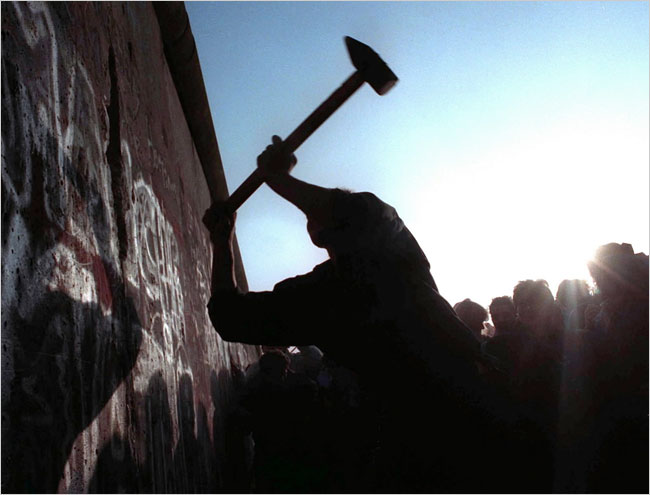
Seems crazy, all of it. Okay maybe the idea that everyone was a communist in the 1980s is a little crazy too, but the ability to connect and communicate on this level certainly makes it seem like they were. In November of 1989, the BBC wrote an article about the fall of the Berlin Wall that sort of sums up the last 20 years of communications:
"At midnight East Germany's Communist rulers gave permission for gates along the Wall to be opened after hundreds of people converged on crossing points. They surged through cheering and shouting and were be met by jubilant West Berliners on the other side. Ecstatic crowds immediately began to clamber on top of the Wall and hack large chunks out of the 28-mile (45-kilometre) barrier."
Wednesday, February 23, 2011
The myth of exponential knowledge
It doesn't take an expert critical thinker to see the huge hole in this line of reasoning. The reason this is a somewhat meaningless factoid is that there has always been more knowledge in the world than we could possibly teach to students. I can remember sitting in the library on SUNY Stony Brook's campus and looking around at the over-stuffed shelves of books on just one bookshelf on one floor and thinking "I will never be able to read even a respectable fraction of the books in here."
This should be obvious prima facie to any objective person, yet that quote gets passed around, re-tweeted, quoted, time and again in EdTech circles. Why?
My theory is that many educators would rather teach their own curriculum or let students design their own curriculum than deliver content designed, sequenced and scaffolded by others. I can understand this sentiment and relate. Having autonomy is a wonderful feeling for teachers and students alike. Just because it feels great and makes you look forward to learning doesn't mean it is the best way to educate an individual, however.
I sat on a curriculum planning team and got to see firsthand that the sequence and scaffolding of the concepts were well thought-out. The age-appropriate lessons for 4th grade were extensions and expansions of the lessons for 3rd grade. The lessons for 3rd grade were extensions and expansions of the lessons for 2nd grade and so on up and down the line. I once had a discussion with Clay Shirky about Math curriculum and he unequivocally told me that the current progression is about as good as he can imagine.
Curriculum is about giving people a foundation to learn more. Cognitive science teaches us that people learn things that build on previous knowledge. This latticework of previous knowledge is called a schema. In other words, skipping steps or zig-zagging around a well-planned sequence of lessons makes learning more difficult.
A curriculum is not meant to be a complete information dump of an all-encompassing human knowledge base. It is meant to provide a broad enough schema for people to absorb and internalize new understandings as they encounter them. Information that does not connect to our existing schema is either ignored or quickly forgotten. Once we understand this fact about how we learn we can see how off the rails the conclusions we draw about exponential information can be.
So let's translate conclusions people draw from Schmidt's quote into the language of cognitive science:
"We need to spend less time building the schemata vital to acquiring new understandings and spend more time teaching people how to do keyword searches on Google for things they won't understand once they read them."
Okay, maybe that's a bit snarky, but it is also accurate.
Curriculum designers are knowledge cartographers- they have been down the road we want our students to travel and they share their experience. We don't need to re-invent the wheel ourselves because we have the benefit of the wisdom of experienced designers.
There is a counter-lesson in here though. Maps get updated because roads and rivers change course. I am a firm believer that curriculum needs to be examined and tweaked on a regular basis, but to discard acquired knowledge as "mere facts" is to deeply misunderstand curriculum design. Is there a kernel of truth in Schmidt's statement? Yes, I think there is more than a kernel in fact. What this means for us as educators is that curriculum design is more important now than ever because it is becoming more difficult to build a broad enough general schema.